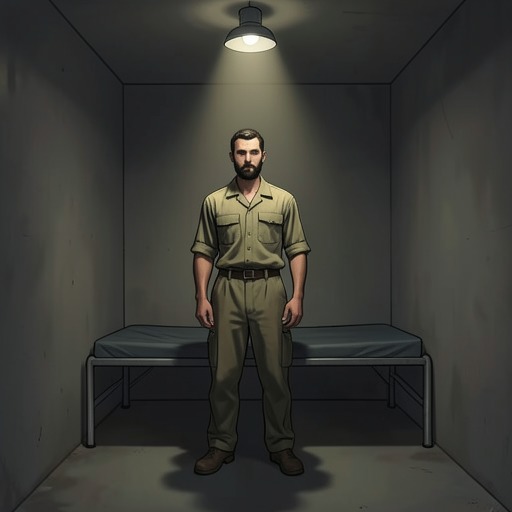
Ted Conkaffey’s remand imprisonment
Crimson LakeTed Conkaffey’s remand imprisonment lasts 241 days, beginning with his arrest at work and ending without the clarity of an acquittal. The experience strips away his police career, former colleagues, and freedom, then leaves him confronting a public that continues to treat the withdrawn charges as proof of guilt. His account makes prison both a system of enforced routine and a pattern of submission that follows him into life outside.
Arrest and the Collapse of His Former Life
A week after Claire Bingley reappears following her ordeal near Mount Annan, Ted goes to work as usual. He has kissed his wife and infant daughter goodbye, stopped for toast and coffee, and taken the escalator to the third floor of New South Wales Police headquarters on Charles Street, Parramatta. As a drug-squad officer, he has been monitoring a suspected drug-importing gang with Davo, Morris, and Frankie. Nothing about the morning initially marks it as different from an ordinary working day.
The change arrives through small signs of exclusion. Around ten, Ted notices whispers and strange looks among colleagues. At eleven, Davo, Morris, and Frankie are called away to an interview room without him. A colleague from the fraud squad later tells him that the station chief wants to see him, but gives no reason. The ordinary meal at the station cafe becomes, in retrospect, his last meal not issued by the state for months.
Davo, Morris, and Frankie begin questioning him. Their involvement is a conflict of interest, but their distress and personal connection to Ted do not prevent them from entering the interrogation room. After a couple of hours, the questioning is handed to homicide detectives; the eventual charges will include attempted murder. Ted cannot bring himself to eat during the fourteen hours of interrogation. That night he sleeps in the cells at his own station, trying to catch the attention of officers he knows as they pass his door. They have been ordered not to speak to him. In a single day, colleagues who had shared work and social life with him become inaccessible, and he is recast as an enemy.
A Life Organized by Rules
Ted describes survival inside prison as requiring near-total submission to its routine. The inmate, in his account, reads the orientation handbook and follows its directions in every situation, keeping his cell and uniform immaculate, his papers filed, and his dealings with staff and other inmates courteous and professional. The point is not simply neatness: following rules allows him to avoid having to make independent judgments in an environment where he sees that judgment as a source of risk.
The prison’s procedures reach across ordinary routines and emergencies. During a fight, the inmate is expected to drop to the ground, place his hands on the back of his head, and wait for instructions. At a cell inspection, he remains quiet, follows staff directions, and makes his belongings available. He must also keep up with rule changes; ignorance does not excuse a breach. Ted presents this method as practical, not heroic: organization and obedience make time more bearable by turning the prisoner into a functioning part of a larger machine. His image of the inmate as a precisely fitted cog captures the bargain. The system supplies the rules, and the individual survives by fitting himself to them.
Charges Withdrawn, Suspicion Retained
Ted is never acquitted of the rape and attempted murder of Claire Bingley. He is committed to stand trial, a decision that tells the public there is enough evidence for a prosecution to proceed. Halfway through the trial, the Director of Public Prosecutions withdraws the charges, explaining that the evidence cannot satisfy a properly instructed jury beyond reasonable doubt. For Ted, that distinction is crucial: the withdrawal does not declare him innocent or settle what happened. It reflects a decision not to continue with the evidence then available, while leaving open the possibility that the charges could return if stronger evidence emerged.
The result is a release without resolution. Ted does not know whether Claire’s case is still being investigated, and none of his former friends speaks to him again. He wakes each day aware that he might be arrested and sent back to prison. The public judgment is similarly resistant to the legal outcome: later, Fabiana tells him that Australia does not believe he is innocent, and men in a bar recognize him when he tries to order a beer. His arrest and imprisonment therefore continue to define his place in the world after the prison doors have opened.
After Release: Routine Without the Institution
Just over two months after arriving in Crimson Lake, Ted recognizes that he has lost the structure prison once imposed. Outside, nobody is writing his rules. He has taken up drinking, rented a rundown property on the edge of nowhere, and withdrawn from society. He sometimes goes days without showering and sometimes forgets to eat until hunger forces itself on his attention. Where prison routine had provided a rigid framework, freedom initially leaves him tumbling without one.
Ted decides to restore order through ordinary actions: unpacking his belongings, stopping his practice of sleeping on a blanket, and contacting a furniture store in Cairns. He does not order a television, afraid of seeing himself. The small domestic choices mark a difficult turn toward re-entering life, but not a return to ease. His remand has trained him to survive by minimizing uncertainty and personal judgment; after release, he must build structure for himself while the unresolved case and public suspicion remain. The prison’s most lasting effect is thus not only the 241 days it takes from him, but the survival logic it leaves behind.